
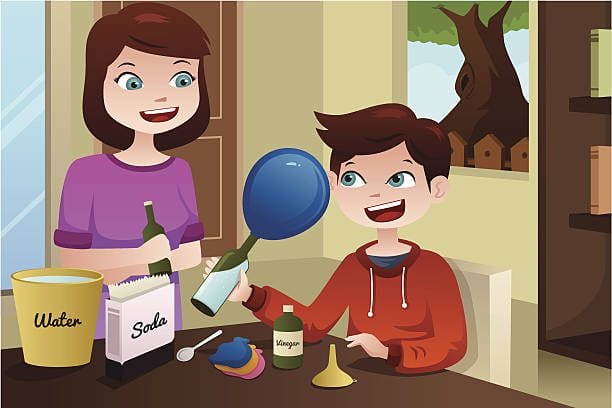
1. Introduce the concept of science experiments and their importance in understanding the natural world.
2. Gather a selection of simple and safe science experiments that can be conducted indoors, such as making a volcano eruption with baking soda and vinegar, creating a rainbow using a glass of water and sunlight, or growing crystals.
3. Divide the children into small groups and assign each group a different experiment.
4. Provide the necessary materials for each experiment along with clear instructions on how to conduct it.
5. Allow the groups time to work on their experiments, encouraging them to think about the scientific principles behind each one.
6. After the experiments are completed, have each group present their experiment to the others. They can explain the hypothesis, the procedure, the observations, and the conclusions.
7. Encourage questions and discussions after each presentation to foster logical-mathematical intelligence and critical thinking.
8. Set up the completed experiments as a "Science Experiment Showcase" for all the children to explore and learn from.
This activity enhances naturalist intelligence as children engage in hands-on scientific exploration. They also exercise logical-mathematical intelligence by following experimental procedures and drawing conclusions. Additionally, visual-spatial intelligence is stimulated through observing and understanding the visual components of the experiments.
Make sure the experiments are age-appropriate, safe, and conducted under adult supervision as needed. This activity not only promotes learning but also ignites curiosity and a deeper interest in the world of science.